CLE Presentations
Substantive continuing education on visual strategy, cognitive science, and demonstrative evidence for litigators.
Substantive continuing education on visual strategy, cognitive science, and demonstrative evidence for litigators.
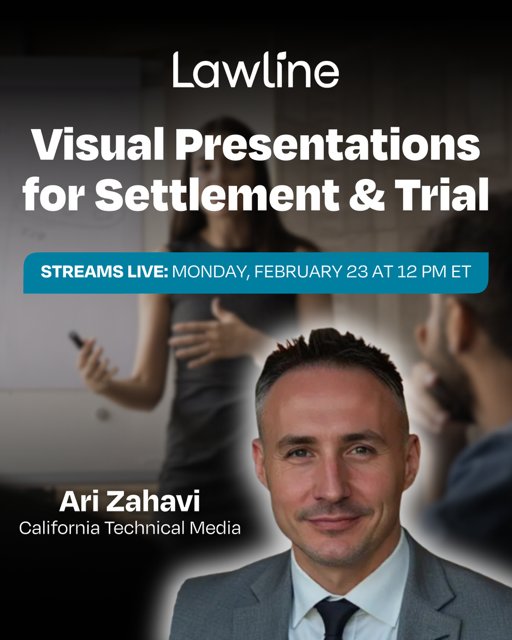
Ari Zahavi, J.D., presents continuing legal education programs for national CLE providers, government attorneys' offices, trial lawyers' associations, and law firms. These are not vendor demos. They are substantive sessions on how visual cognition, narrative control, and evidentiary foundations shape outcomes at mediation and trial.
The core thesis: litigation is a battle of meanings. Facts may be shared, but the meanings constructed from them—accident or deliberate action, carelessness or best option available, justified or outrageous—are created in the minds of jurors, mediators, and judges. Visual presentations are tools for controlling those meanings.
The presentations draw on twenty years of experience across over 1,600 visual matters and cover the cognitive science behind why visuals persuade, how to design visual strategy around verdict architecture, and how to anticipate and defeat opposing visual arguments.
A structured framework for thinking about visual evidence as a litigation tool, not a production task.
Cognitive load theory, the picture-superiority effect, and dual coding: why jurors simplify complex testimony on their own (often incorrectly) and how well-designed visuals prevent that by reducing extraneous cognitive load and planting stable memories that survive into deliberation.
How visual hierarchy determines what jurors treat as the main fact versus background context. Framing, definitional anchoring, case vocabulary, and why the side that supplies the first coherent mental model often defines what all later evidence means.
Working backwards from the verdict form: identifying each required element and burden, mapping what jurors must conclude, and building a visual plan where every graphic resolves a specific confusion, invites an inference, plants a memory, and supports a decision step.
Segmenting, progressive disclosure, and teaching standards, mechanisms, and causation as separate visual steps. How to present technical cases without turning the trial into a lecture, and how to control not just comprehension but inferences.
Why credibility is a separate design objective from persuasion. Witness-centric authentication, source transparency, the importance of showing what you know and what you don't know, and how restrained visuals outperform flashy ones under cross-examination.
How to identify assumptions embedded in the opponent's graphics and force them into explicit words. Why waiting until cross-examination to poke holes leaves the jury anchored to the wrong model, and how to offer an alternative coherent structure early.
Visual strategy tailored to personal injury and trucking, medical malpractice, products liability, commercial disputes, and IP litigation. Each area has distinct visual priorities, common defense counter-strategies, and specific credibility constraints.
How to structure the visual workflow within a trial team: defined roles, iterative production, and a practical framework for deciding when the cost of visual presentations makes financial sense for a case—and when it doesn't.
The side that provides a more coherent, comprehensible, memorable picture of the case—and one that appears fair and believable—gains a significant advantage. People on the jury want to be able to say, honestly and with a clear conscience, I agreed with this side because I believed them.
Presentations are typically 60 to 90 minutes and can be structured for CLE credit in most jurisdictions. Written course materials are provided. Programs can be delivered live, via webinar, or as recorded on-demand content.
CLE presentations are available for bar associations, trial lawyers' associations, government attorneys' offices, law firm retreats, and litigation support conferences. Programs are tailored to your audience and CLE credit requirements.
Schedule a Conversation
Phone: (949) 550-1100
Email: Cases@CaliforniaTechnicalMedia.legal